Research led by a UC Davis Ph.D. student shows that AI models can maintain response quality while using far less energy on existing hardware. The work received the Best Paper Award at MLSys 2026, a leading machine learning and AI systems conference.
Researchers found that the structure and composition of materials can dramatically increase how often fusion happens at low energies. With a better understanding of the mechanism behind that effect, we may eventually be able to design materials that improve neutron sources or other fusion-based technologies.
The path to a world without dementia starts with a brain tissue sample. Researchers at the University of California, Davis, are developing AI-driven tools to analyze vast digital archives of brain tissue scans — work that cannot be done at scale by humans alone — to better understand dementia and improve diagnosis and treatment.
The University of California, Davis, has been selected as a core member of the Pacific Intermountain Network for Education in Semiconductors, a regional node of the National Network for Microelectronics Education, or NNME, designed to strengthen and scale the semiconductor workforce across the western United States.
For innovative research on chips that can sustain high speeds without sacrificing power or signal amplification, a feat necessary for realizing the wireless networks of tomorrow, Phat Nguyen has received the Zuhair A. Munir Award for Best Doctoral Dissertation in Engineering at UC Davis.
Electrical and computer engineers at UC Davis have theoretically demonstrated a thermophotovoltaic system, a renewable energy method whereby heat is turned into electricity, that can achieve a power conversion efficiency rate of 50%, more than double that of commercially available solar cells.
Associate Professor of Electrical and Computer Engineering Marina Radulaski and Associate Professor of Computer Science Mohammad Sadoghi are among this year’s class of Chancellor’s Fellows at the University of California, Davis. The distinction is given to early academics doing exemplary work in their fields.
In 2016, Aggie Engineers set the stage with a groundbreaking paper on the methodical implementation of deep convolutional neural networks. Now, one of the world’s largest international conferences on silicon semiconductor research, ASP-DAC, is recognizing the paper as the most influential article published over the last decade.
A recent study led by electrical and computer engineers at UC Davis, and reported in Advanced Photonics, has demonstrated that the power of a spectrometer can be replicated on a microscopic chip. This innovation paves the way for next-generation medical diagnostics and agricultural and environmental remote sensing.
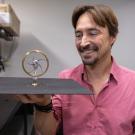
Engineers at the University of California, Davis, have invented a device that can generate mechanical power at night by linking the natural warmth around us to the cold depths of space. The invention could be used, for example, to ventilate greenhouses or other buildings.