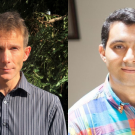
Researchers from both UC Davis and George Mason University have recently identified a vulnerability in the cloud scheduler which can open the door for future micro-architectural attacks deployed on the cloud.
A micro-architectural attack is a type of attack strategy that exploits the design flaws in hardware to affect the execution of certain programs or extract secret data from victim programs. It has been proven that micro-architectural attacks can be a serious threat to cloud infrastructures.
UC Davis’ electrical and computer engineering department welcomes two new faculty members this fall: associate professor Avesta Sasan and professor Junshan Zhang.
Cyber security is a worldwide concern. Our systems, infrastructure, and indeed our society rely on it. Many places study the security of systems in general, of software, and of the policies and procedures supporting them. But the security and assurance of hardware is much less studied. As our infrastructure and systems rely on commercial off-the-shelf (COTS) equipment, the security and assurance of hardware is integral to our systems, infrastructure, and society. Hardware security arises in a number of places.
Weijian Yang,assistant professor of electrical and computer engineering, recently received the honor of being a finalist for the Science and PINS Prize for Neuromodulation. The prize is co-sponsored by the American Association fo
Assistant professors Marina Radulaski and William Putnam, both electrical and computer engineers recognized in 2021 with CAREER awards from the National Science Foundation, have been using these prestigious grants to educate and inspire new generations of researchers.
Erkin Şeker, associate professor of electrical and computer engineering, and his team have adapted a pre-Columbian era jewelry making process to create the nanoporous gold they use for biomedical applications. “Depletion gilding [purifying gold by removing other elements] would start with an alloy of copper and gold called tumbaga. Artisans would use a chemical reaction to remove the copper and leave behind the gold, which gives the golden finish to the artifacts.
The Department of Electrical and Computer Engineering Associate Professor Omeed Momeni, in collaboration with Department of Plant Sciences Associate Professor Tom Buckley, have received a $650,000 Seeding Solutions grant from the Foundation for Food & Agriculture Research (FFAR) to develop a low-cost, compact and
In the Spring of 2020, when the pandemic was just beginning, everyone’s lives were disrupted. Schools and offices closed, friends and family had to remain separate, and masks and social distancing came to represent the “new normal”.