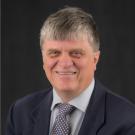
In Memoriam: Andrew Dienes, Innovator in Ultrafast Lasers and Distinguished Faculty Member
The Department of Electrical and Computer Engineering is saddened to announce the passing of Professor Andrew Dienes, a seminal figure in the field of ultrafast optics and a dedicated member of the UC Davis faculty for decades.
Born in Hungary in 1939, Professor Dienes brought a world-class research pedigree to Davis. After receiving his Ph.D. in physics from the California Institute of Technology, or Caltech, in 1967, he spent six transformative years as a member of the technical staff at Bell Laboratories in Holmdel, New Jersey.
The Bell Labs Era: Breaking the Time Barrier

During the late 1960s and early 1970s, Bell Laboratories — now known as Nokia Bell Labs — was the epicenter of a global race to generate shorter and shorter optical pulses. Dienes was a central figure in this "golden age" of photonics, working in the Quantum Electronics Research Department alongside future Nobel laureates and industry leaders. His contributions during this period were not merely incremental; they fundamentally altered the architecture of laser systems.
Prior to Dienes' work, generating short pulses often required "active" modulation, using external electronics to switch the laser on and off. This method was limited by the speed of the electronics. Dienes, in close collaboration with Erich Ippen (later a professor at MIT) and Charles Shank (later director of Lawrence Berkeley National Laboratory), pioneered the transition to passive mode-locking. In their seminal 1972 paper, "Passive mode locking of the cw dye laser," the team demonstrated that a saturable absorber dye placed inside the laser cavity could self-modulate the light much faster than any electronic switch. They achieved continuous pulse trains with durations of 1.5 picoseconds, the shortest optical pulses ever generated at the time. This shattered previous records and opened the door to time-resolved spectroscopy, allowing scientists to observe chemical reactions and physical processes as they happened on a molecular timescale.
While the physics of mode-locking was revolutionary, Dienes also solved a critical engineering hurdle that made these lasers practical. Early dye lasers suffered from severe optical distortions (astigmatism) because the dye jet, a stream of liquid flowing through the laser, had to be placed at an angle. Working with Herwig Kogelnik (a legend in electromagnetic theory), Dienes co-developed the astigmatically compensated folded cavity, often called the "Z-fold" cavity. This design used specific mirror angles to cancel out the distortions introduced by the dye jet, allowing the laser beam to be focused down to the tiny, high-intensity spot necessary for non-linear optics without losing beam quality. This specific 3-mirror or 4-mirror "Z" configuration became the standard design for virtually all ultrafast dye lasers (and later Ti:Sapphire lasers) for the next 30 years.
The techniques Dienes developed at Bell Labs provided the direct experimental lineage for the Colliding-Pulse Mode-Locked, or CPM, laser. While the CPM laser was famously demonstrated by his collaborators shortly after his departure to academia, Dienes remained deeply involved in the physics of these systems. He later helped demonstrate, from his lab at UC Davis, how counter-propagating pulses in these colliding-pulse systems could compress pulse envelopes to under 0.1 picoseconds (100 femtoseconds), a regime previously thought impossible.
The UC Davis Years and Academic Reach
Dienes joined UC Davis in 1974 following a Visiting Mackay Professorship at UC Berkeley, becoming a full professor in 1976. He held an adjunct professorship at UC Berkeley throughout his career, where he collaborated with Professor John Whinnery and advised research on double mode-locking. This work successfully produced highly synchronous picosecond pulses at two wavelengths. He was instrumental in establishing the UC Davis campus as a global hub for photonics research, known for his ability to bridge fundamental laser physics with active device engineering.
During his tenure at UC Davis, Dienes expanded his focus from dye lasers to the cutting edge of semiconductor and solid-state lasers. In a prolific collaboration with Professor Jonathan Heritage, he led the development of the first successful model of spectral distortion and pulse shape evolution in semiconductor lasers. Their joint work significantly advanced the understanding of subpicosecond pulse evolution in semiconductor amplifiers and high-power ultrafast laser diodes. His other theoretical contributions were equally rigorous. Collaborating with S. P. Dijaili and Professor J. S. Smith, Dienes developed dispersive-pulse ABCD matrix formalisms, a mathematical framework that proved critical for understanding time-lens systems and complex pulse propagation.
Dienes also drove innovation in nonlinear optics and novel materials. Working with Distinguished Professor André Knoesen, he investigated ultrashort-pulse second-harmonic generation and nonlinear polymer thin-film structures. This research led to a notable professional reunion with his early Bell Labs collaborator, Charles Shank. Together, Dienes, Knoesen and Shank demonstrated that organic thin films and poled polymer structures could be used to both generate and diagnose femtosecond pulses.
Beyond Davis, Dienes maintained strong ties with the wider academic community. A globally respected scientist, he also completed sabbatical visits at the University of Bordeaux in France, the Weizmann Institute in Israel and the Technical University of Vienna in Austria.
A Dedicated Teacher and Mentor
Professor Dienes was as committed to education as he was to research. He was responsible for teaching junior-level required courses, including introduction to electromagnetics, an important but difficult subject for most students. Extremely dedicated to his craft as an instructor, Dienes constantly revised his lecture notes to reach out to students who had difficulties grasping abstract physics concepts. He made himself available for extra office hours, created new homework problems and solutions, always working with pencil on yellow pads in his characteristic methodical style. He created the photonics program at UC Davis and developed new courses in fiber optics and nonlinear optics to introduce students to emerging topics at the forefront of the field.
Many of these students decided to follow in his footsteps to research electromagnetism or related subjects. Professor Connie Chang-Hasnain, who, as an undergraduate at UC Davis, was mentored by Dienes, and went on to Bellcore as a member of technical staff, then to a faculty position at Stanford, and ultimately to UC Berkeley, where she became the John R. Whinnery Distinguished Chair Professor of Electrical Engineering and Computer Sciences. Elected to the National Academy of Engineering in 2018 for her pioneering contributions to wavelength-tunable diode lasers and VCSEL photonics, and serving as President of Optica in 2021, Connie's remarkable career stands as a testament to the lasting influence of Dienes’ early mentorship and his vision in building the photonics program at UC Davis.
As a graduate advisor, Dienes was extraordinarily patient and generous with his time. He provided constructive criticism when necessary but was quick to praise good ideas to encourage innovation. A natural team builder, he frequently hosted his graduate students for elaborate five-course meals, fostering a sense of community and collegiality that extended well beyond the laboratory. His mentorship style balanced high scientific standards with genuine care for his students' development and well-being.
A Life of Broad Interests
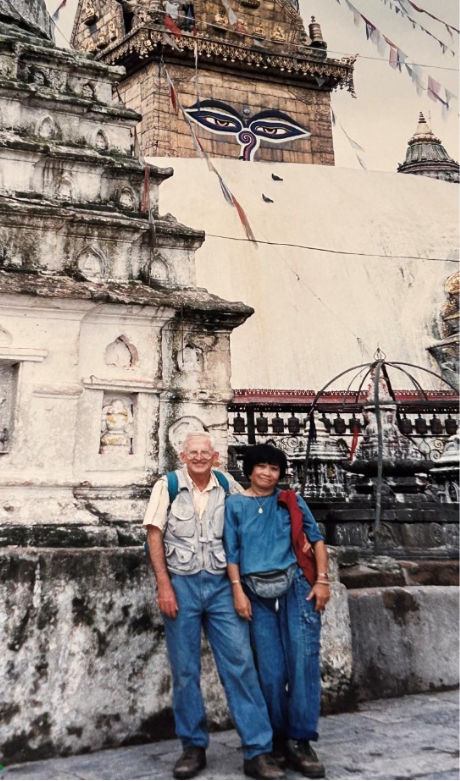
Outside the laboratory and classroom, Dienes cultivated a rich array of interests that reflected his intellectual curiosity and appreciation for culture. Trained as a classical musician, he played the cello and was an avid amateur classical music critic. He was an enthusiastic hiker and snorkeler, often combining these pursuits with his passion for photography. Dienes was also an accomplished cook who took great pleasure in preparing meals for colleagues and students alike.
His fascination with languages was lifelong. In addition to English and his native Hungarian, he spoke some Russian, Chinese and plenty of Spanish — a skill he continually honed, and which reflected his international outlook and connections to the global scientific community. Dienes was generous with his knowledge and time, sharing his diverse interests as readily as his scientific expertise.
Legacy
Dienes leaves behind a legacy of scientific excellence and a profound impact on the students and faculty with whom he worked. His contributions to the development of mode-locked lasers and ultrafast techniques helped shape the modern landscape of photonics, while his dedication to teaching and mentorship influenced generations of engineers and scientists. He will be deeply missed by the UC Davis community and the broader photonics field worldwide.