COFFEE Brews Community, Opportunity for Electrical and Computer Engineering Students
Electrical and computer engineering students at the University of California, Davis, run on COFFEE.
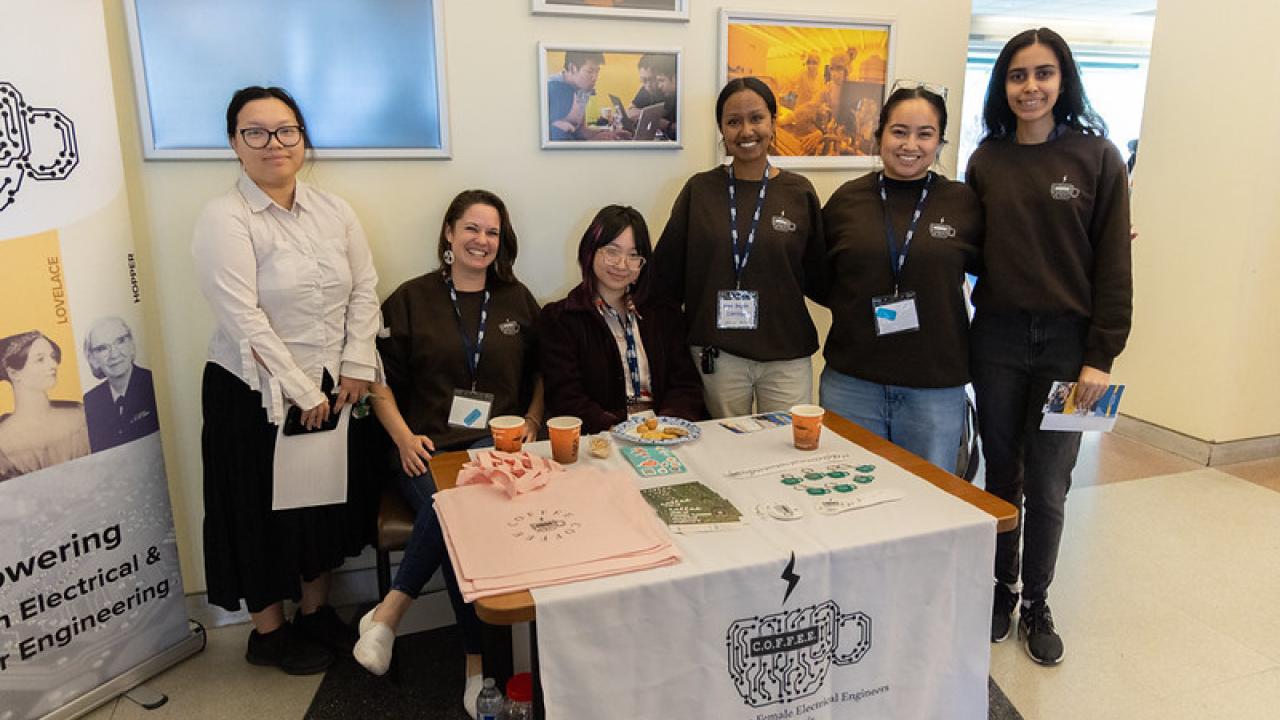
COFFEE, or the Club of Female/Femme Electrical Engineers, is a student-run organization in the Department of Electrical and Computer Engineering that offers academic support, networking opportunities and community, especially among women in a traditionally male-dominated discipline.
The club began in 2018 as a way to bring students together for study sessions as they navigated the tough transition to upper-division coursework.
Now, COFFEE is a central support network with over 150 members making visible, impactful changes to student life. The club only continues to grow, with leadership regularly brewing up new ideas to support and enrich the academic experience for all students.
A Foundation of Community First
A group of women electrical and computer engineers first dreamt up the idea for COFFEE while they were studying amid the fluorescent lights and chatter of students pulling an all-nighter in the 24-Hour Study Room in Shields Library.
They were showing up for each other to help work through homework for upper-division classes in electrical and computer engineering. As women in a male-dominated major, they found the transition to the advanced course series tough without a built-in network. There was another club for students studying electrical and computer engineering, but it primarily focused on fostering industry connections for success after graduation.
There was a need for a club that supported students through their undergraduate experience and built community. There was a need for COFFEE.
Among those students studying that night was Veronica Contreras ’20, who took the idea to Victoria Liera ’22 and Vanessa Liera ’22. Together, they founded COFFEE during the 2019-2020 academic year.
The Liera sisters and Contreras envisioned the club as a way to bring women engineers together, but the club was always open to all who were interested.
“We wanted to make COFFEE a formal space that we could use to welcome students and show that there’s student support for them if they need it,” Contreras said.

An Outpouring of Support
Communal study sessions were among COFFEE’s first events for electrical and computer engineering students.
By the time the Liera sisters graduated in 2022, the club had expanded greatly. Beyond social hours, the club organized community events, a mentorship program and an end-of-the-year banquet to celebrate its community and showcase what COFFEE had accomplished over the past school year.
Victoria Liera mentioned that there was some fear that the club would soon shutter without the original leaders. Instead, the club has only continued to grow. Now, there are more than 150 active students in the club, with more students showing up to public facing events.


The increased size has not dampened the genuine sense of connection. When current co-president Nayana Vallamkondu switched from biomedical engineering to electrical engineering two years ago, COFFEE was her lifeline.
“I was just a random person who didn’t know anyone while everyone else knew each other,” Vallamkondu said. “In my classes, I didn't see as many girls, but when I came to COFFEE, all the girls from the major were in one place. It felt amazing.”
Her fellow co-president, Rebeka Hang, also an electrical engineering major, had a similar experience. She turned to the club for community as a first-year student.
“COFFEE has been a resource for me, a place where I can find like-minded people,” she said.
For Vanessa Liera, the growth of the club and the success of members like Vallamkondu and Hang means a lot.
“It reminds me that I wasn’t alone in what I was feeling and that our mission was important,” she said.
With Time, It Only Gets Stronger
While COFFEE’s goal of supporting women remains at the forefront, the club’s mission has evolved to serve as a cornerstone of the Department of Electrical and Computer Engineering.
COFFEE is the leading club in the department to plan undergraduate events, such as social hours, technical workshops and industry networking opportunities. The club's events have been so successful that companies such as Intel and Texas Instruments have reached out to COFFEE’s leadership team to plan upcoming outreach events, rather than the other way around.
The club also writes a newsletter with departmental need-to-knows, tips and upcoming events that goes out to every electrical and computer engineering student.
Vallamkondu and her co-president Hang are always looking for new ways the club can support students.
For example, with the help of their leadership team, Vallamkondu and Hang recently launched an educational outreach event called E-Crafts.
E-Crafts, part of the Northwest-AI-Hub Workforce Development Program, which prepares students for careers in AI, semiconductor manufacturing and more, is a hands-on learning experience introducing students to advanced technology concepts through arts and crafts. Students learn concepts such as magnetism and polarity through simple designs, such as origami with electrical wires woven in, to demonstrate how circuits work in things such as smartphones.


“A handful of COFFEE members have minimal project experience, so this introductory workshop helps build confidence in making circuits,” Hang said. “It allows students to be creative while practicing their electrical engineering skills.”
The class can be taken by any student who might be intimidated by the math and science underpinning engineering.
Fueling Tomorrow
As COFFEE continues to grow, its leadership is focused on expanding career awareness for students.

While the department has strong ties to fields like semiconductors and radio frequency technology, Vallamkondu and Hang want to highlight a broader range of pathways.
“I think it's important that students get exposure to all kinds of fields they can go into with the degree they have,” Vallamkondu said.
Plans include panels featuring students from different career backgrounds, along with continued investment in mentorship, networking and academic support.
COFFEE is also working on ways to conduct outreach to high schoolers and middle schoolers in the Greater Sacramento Area. So far, club leadership has partnered with the UC Davis Early Academic Outreach Program to host a workshop, with more to come.
“COFFEE has become the department's most influential student club through its dedicated mentorship and diverse programs on supporting students,” said Saif Islam, chair of the Department of Electrical and Computer Engineering. “[The] club’s leadership has fostered a profound sense of community while cultivating enduring ties with industry partners and alumni.”