With parts more than 1000 times smaller than a penny, professors in the Departments of Electrical and Chemical Engineering and Biomedical Engineering collaborate on a device that uses infrared absorptive spectroscopy to identify cancer molecules from drops of saliva.
The recognized project seeks to address malware issues inherent to the Internet of Things, or IoT, the system of physical objects that communicate with other devices over the Internet. These can range from modern thermostats to smartwatches and self-driving cars.
Electrical and Computer Engineering graduate student Micah Karahadian has been admitted into the National Science Foundation’s Graduate Research Fellowship Program, or GRFP, the organization announced.
Electrical and Computer Engineering Professor Jeremy Munday and Assistant Professor William Putnam will work in collaboration on a low energy nuclear reaction, or LENR, project with Lawrence Berkeley National Laboratory. The project is being supported by the U.S. Department of Energy Advanced Research Projects Agency – Energy, or ARPA-E, with $1.5 million in funding over two and a half years.
Built in the lab of Soheil Ghiasi, professor of electrical and computer engineering, the invention is called a transabdominal fetal pulse oximeter (TFO) and can measure a baby’s blood oxygen saturation levels. It can also help prevent unnecessary Caesarean sections.
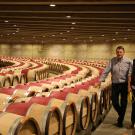
For the first time on a commercial scale, researchers from UC Davis have controlled the redox potential during a wine fermentation, an important step in making winemaking more efficient and reproducible and paving the way for a new generation of experiments in viticulture, microbiology and fermentation.
This winter 2023, the Department of Electrical and Computer Engineering is proud to host many distinguished and accomplished individuals in its weekly seminar series scheduled for Fridays at 2:10-3 p.m. in Young Hall, room 198. Seminars are free and open to the public. More details are available on the department's calendar of events.
Distinguished Professor S. J. Ben Yoo and Professor Q. Jane Gu in the UC Davis Department of Electrical and Computer Engineering were announced as members of the Joint University Microelectronics Program 2.0, or JUMP 2.0, an effort led by a collaboration between the Defense Advanced Research Projects Agency and Semiconductor Research Corporation.
When it comes to finding the perfect blend for advancing winemaking innovation, American entrepreneur Dr. T.J. Rodgers and his wife, Valeta, have found the answer—funding interdisciplinary research by establishing a fellowship to support electrical and computer engineering graduate students working on wine research at UC Davis.
“GraphBLAST” – developed by researchers from Lawrence Berkeley National Laboratory and UC Davis – further enhances the performance of GraphBLAS, a popular collection of graph algorithm building blocks, by overcoming design and performance challenges specific to GPU processors.
Hyoyoung Jeong, a scholar whose work at the interface of bio-integrated electronics and medical applications has gained international media attention, is the newest faculty member within the Department of Electrical and Computer Engineering at UC Davis.
Researchers at the UC Davis College of Engineering have developed a camera that uses a thin microlens array and new image processing algorithms to capture three dimensional information about objects in a scene with a single exposure. The camera could be useful for a variety of applications such as industrial part inspection, gesture recognition and collecting data for 3D display systems.
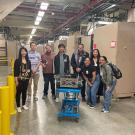
Regardless of their senior design project focus–whether it was on plants, self-driving cars, robots or flying cows–this year’s group of electrical and computer engineering seniors said perseverance, problem solving, project management skills and teamwork were the most valuable takeaways they experienced as part of this year’s senior design projects.