Department of Electrical and Computer Engineering Professor Jeremy Munday recently received a $2.2 million grant from the Defense Advanced Research Projects Agency (DARPA) to deepen our understanding of the quantum forces at work in nanotechnology.
An interdisciplinary team of researchers led by Professor Saif Islam from the Department of Electrical and Computer Engineering will be forging a new partnership with Lawrence Berkeley National Laboratories to create innovative, fluorescence lifetime imaging—a process currently used in the medical field—for improving agricultural practices.
Electrical and Computer Engineering Associate Professor Weijian Yang’s goal is to decode how the brain works in various processes, such as learning and memory formation, through the development of advanced optical methods and neurotechnologies to record and modulate brain activity. Additional interdisciplinary research has applications in biomedical imaging and smart health.
Many of the ECE student members who participate in UC Davis CHEST Center quickly secure positions in academia and industry after graduation where they go on to share the things they learned at the UC Davis CHEST Center for the benefit of others.
Professor Houman Homayoun’s Accelerated, Secure, and Energy-Efficient Computing (ASEEC) Lab in the UC Davis Department of Electrical and Computer Engineering and collaborators at George Mason University received a $1.2 million grant from the National Science Foundation to build secure resource provisioning systems in the cloud.
UC Davis electrical and computer engineering (ECE) professor Marina Radulaski recently earned a Google Research Scholar award for her work in quantum computing.
Electrical and Computer Engineering Professor Soheil Ghiasi's lab has built a transabdominal fetal pulse oximeter to measure a baby's blood oxygen saturation levels non-invasively.
UC Davis electrical and computer engineering (ECE) professor William Putnam’s lab received a National Science Foundation award for using vacuum electronics to generate entangled photons.
UC Davis electrical and computer engineering (ECE) professor Juan Sebastian Gomez-Diaz received a Department of Defense grant for research into ultrathin, ‘smart’ infrared sensors that could revolutionize infrared sensing technology.
Researchers from UC Davis Professor Houman Homayoun's Accelerated, Secure, and Energy-Efficient Computing Lab (ASEEC) Lab and Johns Hopkins University received the Best Oral Presentation Award at the 4th International Conference on Intelligent Medicine and Image Processing (IMIP).
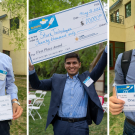
On Friday, April 8, UC Davis' electrical and computer engineering (ECE) department's alumni, students, and professors presented groundbreaking research, creative projects, and inspirational stories at the annual UC Davis ECExpo.
Keysight Technologies, Inc. contributed to lab upgrades. The upgrades include construction, audio and visual equipment and acquisition of state-of-the-art test and measurement instrumentation for 32 workbenches.