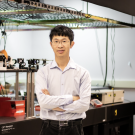
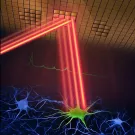
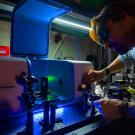
The associate professor spoke with BioPhotonics about a two-photon fluorescence microscope that captures high-speed neural activity developed by his team.
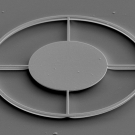
UC Davis researchers have demonstrated an angle etching method for fabricating quantum photonic devices at the wafer scale in silicon carbide. This development has brought within reach the reality of producing quantum nanodevices at scale and, thus, the development of the quantum internet.
The University of California, Davis will be part of a new, $285 million nationwide institute dedicated to advancing research and manufacturing of American semiconductors.
Jeong is one of 12 early-career faculty members who will receive a boost as this year's class of Hellman Fellows at UC Davis. The fellowship includes funding that will directly support Jeong's research into autonomous seizure management.
Professor of Electrical and Computer Engineering Jeremy Munday and his lab have demonstrated a method for controlling the Casimir force, a quantum mechanical effect that draws small objects toward each other. The force can be so strong as to tear components inside a device apart.
Professor Chen-Nee Chuah leads AI/ML efforts within a multidisciplinary team that has received a $6 million grant from the National Institute on Aging to deepen the understanding of the neuropathologic landscape of Alzheimer’s disease, focusing on individuals who identify as Hispanic/Latino.
Researchers in the UC Davis Department of Electrical and Computer Engineering offer insights on devices that operate like solar cells in reverse and can generate power even in the absence of sunlight, offering an alternative route for energy production.
S. J. Ben Yoo, a professor of electrical and computer engineering at the University of California, Davis, leads a project to address large-scale issues in artificial intelligence at the chip scale.
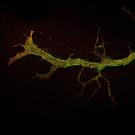
Researchers at UC Davis have developed a new microscope to capture high-speed images of brain cell activity with less harm to brain tissue. The new approach could be used in research with mice to provide a clearer view of how neurons communicate in real time, leading to new insights into brain function and neurological diseases.
Autonomous vehicles can struggle when confronted with unforeseen events, such as a car driving on the wrong side of the road. To address this issue, Professor Junshan Zhang is rethinking how researchers design AVs by letting the machine learning models train themselves.
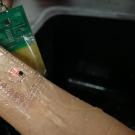
Assistant Professor of Electrical and Computer Engineering Hyoyoung Jeong explores the use of wireless wearable devices for health monitoring. Jeong believes the technology can offer a more practical and economical option for health management compared to current hospital-bound machinery.
Researchers in the Department of Electrical and Computer Engineering are pushing the possibilities of artificial intelligence. They’re exploring the furthest limits of neural network design and are creating next-generation advancements in medicine that are transforming patient care.
Professor Jeremy Munday is part of a College of Engineering project to make around-the-clock solar energy a reality with a novel thermophotovoltaic device.
Researchers at the University of California, Davis, are taking the phrase “follow your gut” to a whole new level: They’re creating microfluidic technology that can map out and probe the neural pathways that form the gut-brain axis for the first time.
When it comes to innovating within applied electromagnetics, Assistant Professor William "Billy" Putnam has found that the best way to move forward is to look toward the past.